The Good Internet: How Fandom Can Reclaim the Web
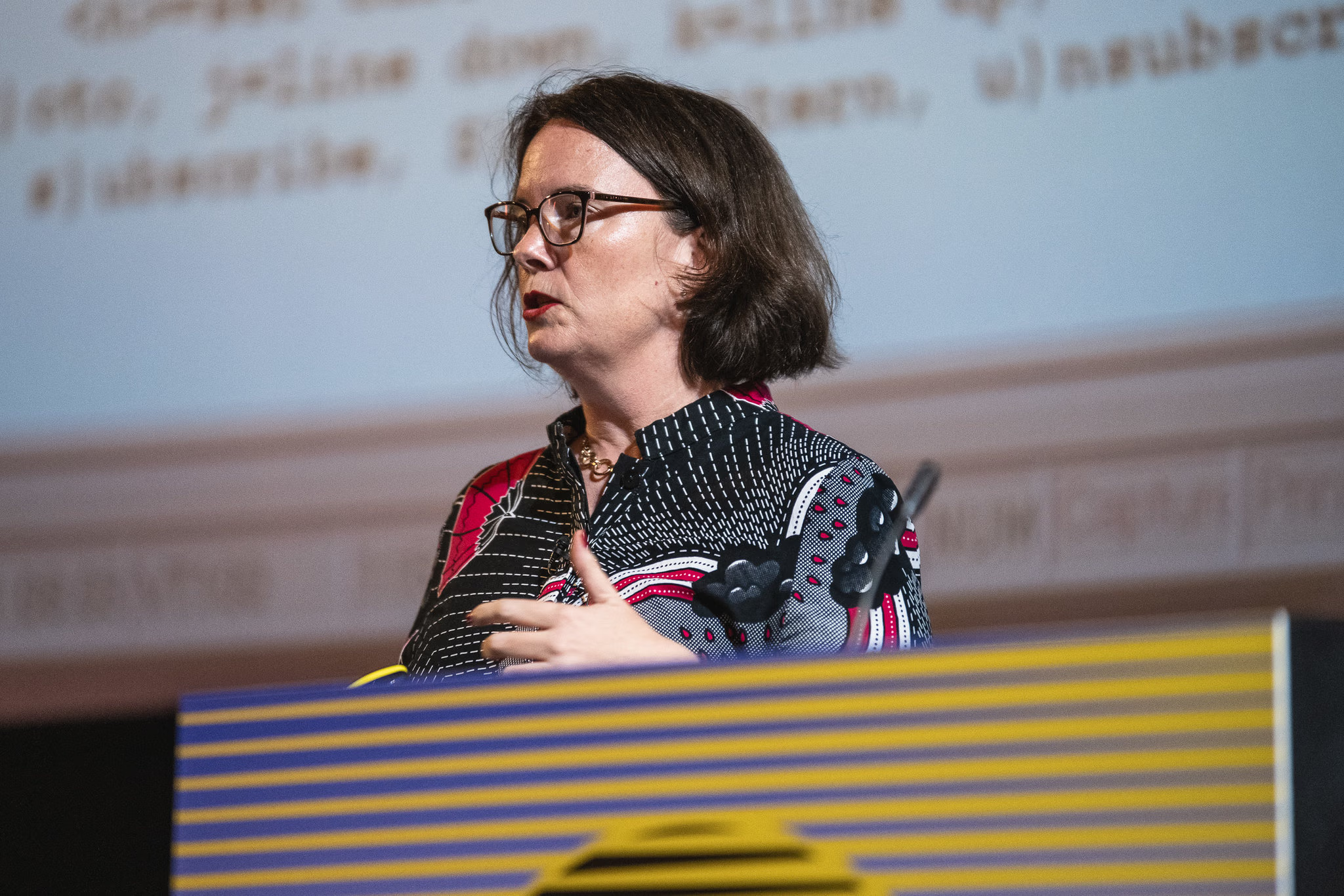
Video
Watch on YouTubeTalk description
Sacha traces the web's fandom roots and shows how small, personal, DIY spaces can help us escape algorithmic doom loops, reclaim creativity, and rebuild a more human internet.
Session Summary
Sacha argues for taking the web back from the platforms by telling the story through transformative fandom, the community that has quietly modelled an open web for thirty years. From Usenet's X-Files debates and the strikethrough purges to Archive of Our Own's twenty volunteer founders and Tumblr's billion-to-three-million collapse, fans keep proving that platforms will betray you and you have to own your own infrastructure. The payoff is a practical programme — custom Bluesky feeds, no-code feed builders, weirding the web with small useless personal sites, working with the garage door up — and a closing promise that the good internet is still out there.
View detailed generated session topics, quotes and video timestamps
The early internet's hand-drawn villages (0m30s)
Sacha opens with a tour of the early mainstream internet — the Yahoo front page, the Xtra homepage in Aotearoa, top-down taxonomies that felt like sections in a newspaper, and the chaotic, hand-painted feel of clicking through to a stranger's site.
"your starting point on the internet depended a little bit about where you began your journey on the information superhighway"
"it was like stepping through a portal that someone had made by hand, and you would find yourself walking down a street where it seemed like every house was painted a different colour, and many of those people were colorblind"
"click the mouse and you can read a speech by President Clinton... a NASA weather movie... a snapshot will show you whether a certain coffee pot at the University of Cambridge is empty or full"
Usenet, X-Files fandom, and Eternal September (2m01s)
She made her first internet home in The X-Files fandom on Usenet — a place where users self-governed via FAQs and community norms — until AOL flooded the gates in September 1993 and changed online culture forever.
"this is where I made my first experience with what we call transformative fandom, a community of fans who don't just consume media, but debate it and reimagine it"
"every September, a whole cohort of US college freshmen would come online and disrupt everything"
"always, there was this recognition that if you didn't like what was happening in a group, you could make your own space"
Surfing requires skill, patience and adventure (5m08s)
The pre-search-engine internet had 10,000 websites and a handful of human-curated directories — the librarian who coined surfing the internet liked the metaphor because, like the sport, it required real skill.
"in 1994, there were around 10,000 websites and 2,500 web servers. That's fewer than the number of people who live just in this area of Brighton"
"in 1994, you could still buy physical directories, books that gave you a guide to the internet"
"like the sport, it required skill, patience, and a sense of adventure"
The war on fandom (5m40s)
Every fanfic she read began with a nervous legal disclaimer — and for good reason, as Anne Rice, Fox and Warner Brothers started sending cease-and-desists, shaping fandom's enduring non-commercial ethos.
"I'm very possessive of my characters. I think it would hurt me terribly to read something involving my characters"
"both the fans and the media companies wanna cheat a little bit. The media companies wanna parade that they're savvy and funnel all the traffic into a handful of sites, but the fans want to have freedom of speech and assembly"
"fans learn to operate in the grey areas of copyright law, creating transformative works for love and not for profit"
What advertisers hate, fans love (8m17s)
The two things that get fans deplatformed — explicit content (especially queer content) and infringing IP — are exactly the two things that built the social heart of online culture in the first place.
"the first thing you need to know about fans is that we will do whatever we like with your characters. The second thing you is that we're horny"
"fandom has a really long proud history of exploring relationships that are never seen on the page or the screen"
"from the outset, it was really clear that there was going to be this consistent tension between fans and the rest of the corporate owners of the internet"
Building our own archives (9m18s)
Fans built Gossamer, the central X-Files archive, complete with a comprehensive tagging system; they taught each other HTML, hosted fanfic on GeoCities, digitised VHS tapes and ripped MP3s on LimeWire.
"this is my first website. It's got some sweet tables. It was a place to host my 'West Wing' fan fiction"
"my fandom friends and I taught each other how to code, design, and maintain our pages"
"we were doing it because we wanted a sense of control over our creative work and because we wanted a sense of permanence"
Tumblr, strikethrough, and Archive of Our Own (11m52s)
LiveJournal's mass-deletion of fan accounts (strikethrough) and the for-profit FanLib startup pushed fans to build AO3 — an open-source archive launched in 2009 with twenty contributors, all women, now hosting 16 million works.
"they take your creative works, your film that you've poured hours and hours of energy into, and they put ads on top of it"
"fans are often the first ones thrown under the bus along with activists, survivors, and marginalised groups"
"AO3... continues to be a shining example of an open source project that welcomes people from non-traditional development backgrounds"
Tumblr's terminal decline (14m29s)
Tumblr combined custom themes, tag-driven discovery and anonymity into a fandom paradise, mainstreamed sex-positivity and social justice, and then nuked its own user base when Apple pulled it from the App Store in 2018.
"Tumblr took on a life of its own, mainstreaming a focus on sex positivity, and cultural identity, and social justice, a full generation before anyone did to misuse the word woke"
"instead of improving moderation trust and safety, Tumblr decided to ban all adult content, sending its user numbers into terminal decline"
"it had been bought by Yahoo for a billion dollars in 2013, and it's sold for $3 million in 2019"
The good internet is still out there (16m31s)
Quoting Molly White: the walled-garden platforms still sit inside an infinite expanse of unenclosed web — we just stopped looking over the walls. This is the article that inspired Sacha to build her second-ever website, a Lego City planner.
"the good internet is still out there. It's just outside the walls"
"we may feel as though we are trapped in these tiny, crowded, noisy spaces, but it's only because we don't see over the walls"
"this site wound up being a finalist in the Tiny Awards, which are awards that exist to celebrate this personal internet, the one that's small and handmade and isn't trying to sell you anything"
Filter world and the everything-app aesthetic (18m34s)
Instagram, Spotify, YouTube and Substack have all converged on an identical purple-gradient everything app aesthetic — Kyle Chayka's filter world, where the algorithm flattens taste into beige Airbnb interior design.
"a Squarespace template will produce a slick site, but as Kyle Chayka calls it, it's like filter world where the algorithm flattens all of our tastes into the same beige, Airbnb coffee shop, drab interior design"
"the corporate landlords are doing it on purpose. They're chasing this everything app aesthetic"
"the independent web never had a coherent aesthetic because of course it didn't"
See one, do one, teach one (20m37s)
Her fifteen-year-old nephew needed a website to advertise his football coaching — she walked him through vibe-coding it with ChatGPT in an hour, and within twenty minutes he was debugging the AI's mistakes.
"within 20 minutes, he was debugging the mistakes that the AI was making, and boy was it making some mistakes"
"the basic vibe coding of the site, super easy, a domain name, really straightforward, pretty affordable. Here's what was hard, hosting"
"fans have always been of the view that we teach one another"
Take back control of your scroll (22m40s)
Bluesky's custom feeds, Graze's no-code feed builder, Blacksky, the Anisota card-game client, and Tapestry's unified feed reader all show what social media looks like when the user — not the algorithm — picks what they see.
"turn your back on for you, and recommended, and you might like, and take back control of your scroll"
"Bluesky doesn't want Caesars, and they don't want to control your scroll"
"instead of consuming the posts in a feed, you're presented with them as cards that you flip through until you run out of stamina like in a game"
We need tools for community, not communication (25m48s)
Every small group — fan subculture, neighbourhood, volunteer initiative — ends up cobbling together WhatsApp, Facebook and email lists, because nothing currently exists that's designed for intentional, discoverable communities.
"we all wind up using some horrible combination of WhatsApp, and Facebook groups, and email lists, and it's all just a disaster because these are tools for communication. They're not tools for community"
"we're all on the verge of message bankruptcy at all times"
"if the first generation of the internet gave us villages and the second generation gave us these gross unlivable mega cities, I want the third generation to give us neighbourhoods"
Weirding the web (28m21s)
Fans built whole fandoms around a fake Scorsese film (Goncharov) and a misread movie poster — the challenge to the audience is to build something small, weird, useless and personal, like the caps-lock-sharing client or the panda-locator site.
"fans love weird shit. We've created whole fake fandoms around a photo of someone's shoe"
"there are over 800 fics tagged 'Goncharov' on AO3, and Martin Scorsese's daughter even texted him to ask if he had seen it"
"build something small, weird, cute, ugly, doesn't matter"
Working with the garage door up (33m06s)
The metaphor of surfing implies motion; the metaphor of platforms implies standing still. The new web aesthetic should be non-linear, outbound, link-heavy, and shared as a work in progress — neighbourhoods over megacities.
"the metaphor of surfing implied motion. The metaphor of platforms implies standing still. You only get anywhere when you leave the station"
"the new web aesthetic is non-linear. It encourages you to move from place to place. It's link-heavy, it's outbound, it's constantly sending you away from the page"
"the web doesn't have to be angry, and rage-inducing, and corporate, and controlled. It can be open, and expressive, and messy, and personal, and social again"
About Sacha Judd
My first computer was a Commodore Vic 20, aged ten. I was one of the first home users of the internet in Aotearoa/New Zealand in 1993, much to the chagrin of my parents who didn't enjoy paying astronomical rates for dial-up for me to hang out in LambaMOO. My first fandom was The X-Files, and I've lived and breathed transformative fan communities ever since. They're the best (and sometimes the worst!) of the internet. Now I'm weirdly micro-famous for giving tech talks all over the world about Harry Styles.