Bias in our products: The case for diversity in tech
Video
Watch on YouTubeTalk description
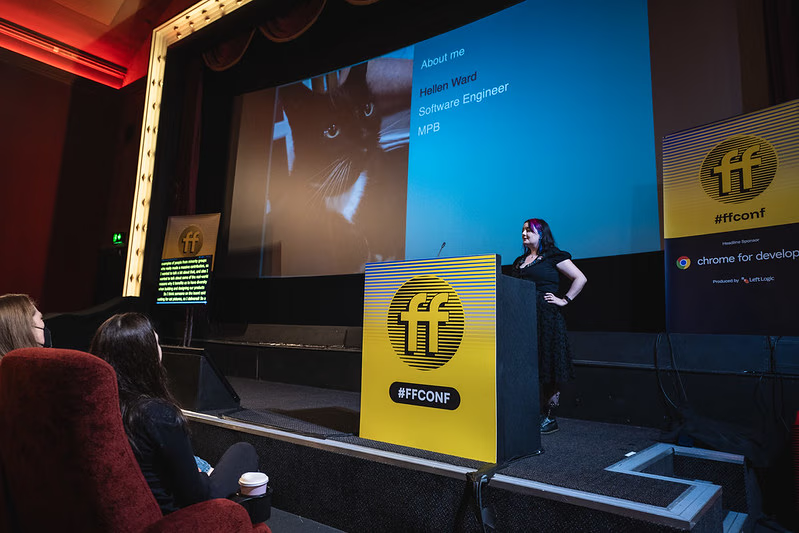
Hellen unpacks how lack of diversity produces biased products—from racially biased soap dispensers to dangerous gaps in AI healthcare—tracing tech’s history, showing modern failures, and urging teams to build more inclusive, representative systems.
Session Summary
Hellen turns her own detour out of a 1990s GCSE classroom into the spine of an evidence-led case for diversity in engineering, then walks the audience through the people the industry quietly forgot. Ada Lovelace writes the first program, the Bletchley women shorten a war, the ENIAC six don't get invited to dinner, Grace Hopper invents machine-independent programming, and Skip Ellis lays the groundwork for Google Docs on a machine he wasn't allowed to touch. The payoff lands in four sharp modern case studies — racist soap dispensers, white-male emoji defaults, gendered job ads, AI that downplays women's symptoms — proving that who's in the room still decides what ships.
View detailed generated session topics, quotes and video timestamps
My unconventional path into engineering (1m33s)
Hellen opens with her own non-traditional route. She did the school Information Systems GCSE in the 1990s, was one of two girls in a class of 25, got a poor grade in an under-funded school, drew the obvious conclusion, and instead studied theatre. She came back to coding in 2017 via codebar and self-taught front-end work. The route mirrors how most women enter the industry.
"my path into software engineering was less than conventional, and this can often be true for women and people from other minority groups"
"I was getting A's and B's in everything else, [so] I kind of thought, well, maybe sadly computing just isn't for me"
"job descriptions are written with a certain kind of candidate in mind — and that candidate will have a computer science degree and a personal and academic background dedicated solely to tinkering with computers, and that certainly wasn't me"
How bad is the diversity problem (4m07s)
The Google headline of 26% women in STEM hides the real numbers. The 2020 APPG diversity report gives 27% across STEM but only 9% if you narrow to engineers. EngineeringUK's 2025 figure is 15.7% — and that's drawn from ONS data with falling survey response rates. Ethnic-minority engineers are at 12-13.6%. LGBTQ+ and disabled engineers are even harder to count.
"women are overrepresented in healthcare — we're 68% of that workforce — but if we narrow it down to just engineers, we get 9%"
"in future, I would love to do a talk where I focus on the other [minority] groups as well, because I believe they all deserve to have their story told"
"they don't paint a picture of a very diverse industry"
The first programmers were women (8m17s)
Ada Lovelace's translation of Menabrea's account of Babbage's Analytical Engine — and her addition of the Bernoulli-numbers algorithm in the appendix — is the first computer program. Written before computers as we'd recognise them today existed.
"in an effort to truly demonstrate how the machine would work, she came up with an appendix which contained an algorithm for calculating Bernoulli numbers"
"this is now considered to be the world's first computer program, written a time before computers as we would even recognise them today existed"
"she didn't just translate it — she improved it. She expanded upon it with her notes and her ideas"
Bletchley Park, ENIAC, Grace Hopper, Skip Ellis (9m20s)
A short tour of the early-industry pioneers. The Bletchley Park human computers. The six women who programmed ENIAC and weren't even invited to the unveiling dinner. Grace Hopper writing the Mark I instruction manual, inventing subroutines and machine-independent programming, then FLOW-MATIC and eventually COBOL. Skip Ellis teaching himself the machine he wasn't allowed to touch, becoming the first Black man with a CS PhD in the US, and building OfficeTalk — the basis of Google Docs.
"their efforts probably shortened the war by a number of years, and likely saved countless lives"
"despite their critical role in preparing the machine for the event, the women weren't introduced, acknowledged, or credited at all on the evening, and they weren't even invited to the celebration dinner"
"Grace was in fact the first person to devise the theory of machine-independent programming languages"
What happened: the nerdy-developer stereotype (15m32s)
As home PCs arrived and the industry's prestige rose, women and minorities were pushed out. Qualifications started being required where they weren't before. And the nerdy male developer stereotype emerged — antisocial, awkward, played computer games all day, no social life. A university professor in one account explicitly said I haven't seen the same level of passion in the women in my class as the men, where passion meant the all-coding-no-social-life pattern.
"women and other minorities began to be pushed out, because this was no longer seen as a low-status job"
"we are far more likely to be responsible for childcare, elder care, school run, housework — even in 2025, unfortunately"
"they couldn't see themselves in this image, and so therefore they think the profession wasn't for them"
Why diverse teams matter: the racist soap dispenser (18m09s)
The viral video of an automatic soap dispenser that won't trigger for a Black hand but does for a white napkin. Nobody on that team set out to build a racist soap dispenser. The whole team was presumably white, and nobody thought to include darker-skinned testers. This is unconscious bias delivered through product.
"I can absolutely guarantee you nobody in that team set out with the intention of producing a racist soap dispenser"
"presumably the whole team was white, and nobody thought to include someone with darker skin in the test group before they shipped the product"
"that's unconscious bias"
Emoji and the unconscious-bias defaults (20m42s)
Until 2016 the emoji codebase was overwhelmingly male and white. The Unicode Consortium used gender-and-ethnicity-neutral language in its spec, but the platform teams unconsciously defaulted to a male white runner, firefighter, scientist every time. Even careful spec-writing couldn't beat the bias. The Unicode Consortium eventually had to mandate diversity explicitly.
"78% of women use emoji compared to 60% of men"
"the Unicode Consortium would tell the platforms to design a runner, and they would overwhelmingly design a male white runner because that's what popped into their heads most naturally"
"even with the best of intentions, gender-and-ethnicity-neutral language doesn't always work, because we're fighting the unconscious bias that's baked into our society"
AI bias: jobs, faces, women's healthcare (22m44s)
Three current case studies: Meta's job-ad algorithm investigated this month by a French regulator for showing mechanic and pilot to men, primary school teacher and psychologist to women. Facial recognition with 0.8% error for light-skinned men and 34.7% for darker-skinned women, now deployed by police and high-street retailers. AI in liver disease missed 44% of female cases against 23% of male — because women have been historically excluded from medical trial data.
"the error rate for light-skinned men is 0.8% compared to 34.7% for darker-skinned women"
"women of childbearing age were more often than not deliberately excluded from trial groups"
"AI will take the case notes... of a female subject and downplay her healthcare needs compared to a male subject with the same health conditions"
You need cultural representation at the creation stage (29m22s)
Closing on a hopeful note: AI image generation has moved from actively erasing disabilities to not erasing them, partly because diverse people are now in the room. The Create Labs CEO's quote is the load-bearing one — if you don't consult the people with lived experiences, then AI will miss them.
"AI has moved from a point where it was erasing people's disabilities during image generation, even when it was asked not to, to a point now where it just isn't"
"if we can involve more diverse team members when we're building, designing and testing our products, then we have a chance of actually intervening in some of these issues"
"diversity in AI starts with who's involved in training and labelling the data. It's about who's in the room when the data is being built. You need cultural representation at the creation stage. If you don't consult the people with lived experiences, then AI will miss them"