Build Better Webs
Video
Watch on YouTubeTalk description
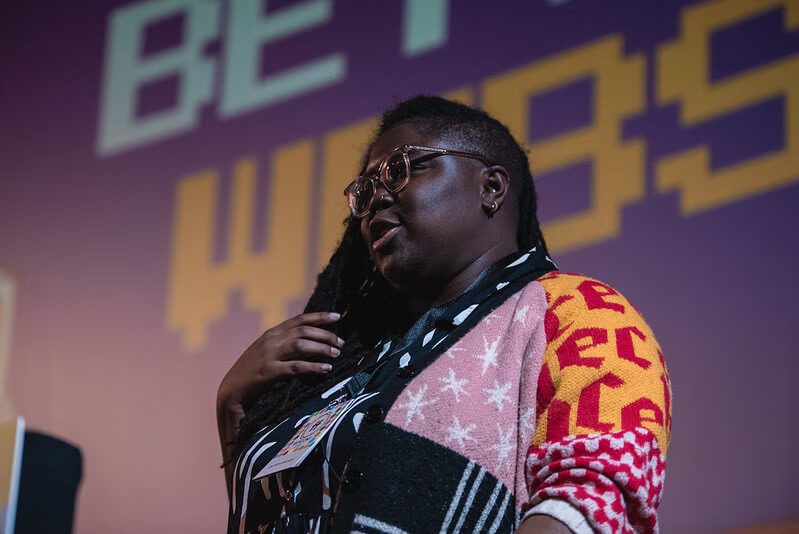
We shouldn't be building "the web" - a monolith, a monoculture - but better webs. Indie webs. Small webs. Solar-powered webs. Poetic webs. All undergirded by healthy roots/infrastructure and interlinked, interconnected and interoperable.
Session Summary
Olu reframes the web as infrastructure rather than product, borrowing Deb Chachra's framing to argue that once a network becomes essential, exclusion from it is a punishment. The IndieWeb's two failure modes get a generous critique: replicating Facebook with better politics is still Facebook, and retreating to a lonely coding cave to build a perfect tool nobody uses is also a dead end. The way through is to build with the community you're already in, treat the non-technical user as the rule rather than the exception, and design your work to be uncapturable, bound so tightly to its users that extraction breaks the thing. What kind of networks do you want?
View detailed generated session topics, quotes and video timestamps
Why I think the web is magic (1m32s)
Olu opens with their stated bias: the web is magic. Anyone can publish anything to anyone at near-zero cost, more people are online than ever, and Arthur C. Clarke's sufficiently advanced technology is indistinguishable from magic is the right frame for what we have.
"we can send messages to people on the other side of the planet near-instantly"
"any sufficiently advanced technology is indistinguishable from magic"
"we're going to cast a spell"
Infrastructure and networks: the framing (4m05s)
The talk is built on Deb Chachra's framing in How Infrastructure Works: water, sewage, gas, roads, electricity, container shipping. The lessons all apply to the web. A network is things connected to other things, that connect people, and networks are the only mechanism we have for sharing and amplifying the benefits of cooperative work.
"networks allow us to communicate, share knowledge and share resources, but networks also allow us to share and amplify the benefits"
"everyone using a network is what makes it better and more valuable"
"Metcalfe's Law... a network's value is proportional to the square of the number of nodes in the network"
Once everyone's on a network, it stops being a luxury (5m36s)
The pandemic showed clearly: when everyone is expected to have internet access for work, school and healthcare, not having it becomes a punishment. Infrastructure increases agency — the ability to get what you want — and once a network is established, exclusion from it stops being a neutral choice.
"once everyone is on a network, it stops being a luxury and becomes a need"
"the height of the pandemic was a good example of this — access to the internet was seen as normal, and nobody expected you not to have it"
"infrastructure increases the agency of everyone who uses it"
Infrastructure can transfer power either way (7m39s)
Infrastructure can destroy or embed power structures. The wealthy claim the majority of the benefits; marginalised people experience most of the harm — displaced for reservoirs, on the wrong side of the bus-fare changes, in the towns that don't get fibre. Today's web has unambiguously embedded the power of Meta and Alphabet.
"infrastructure is a way of transferring power"
"the already powerful claim the majority of the benefits, and the marginalised people are predominantly the ones experiencing harm"
"what you can and can't do is shaped by what is available to you in these systems"
What we shouldn't do: build a new giant Facebook (9m44s)
The instinct make a better one of the same thing doesn't help. Replicating Facebook on better politics is still Facebook. The IndieWeb's other failure mode — each person builds their own lonely little thing in isolation, gets discouraged, gives up — also doesn't help.
"we can't just like replicate the things that exist now"
"lots of tiny, lonely, unconnected things"
"they just go off into their internet cave, their coding cave, and just code a new thing — and no-one uses it, and then they get discouraged, and think nothing can ever change"
Build with the community, not for them (11m17s)
What we need is a culture of building things together. Better governance, accessibility, translation, design, maintenance — not as an aside but as the whole work. The non-technical user is the majority of users in the world, and you should be as close to your own users as possible. Build for the communities you're already in.
"the non-technical user is not an exception, they're a rule"
"we should be as close as possible to being the user when we build things"
"you should be building for people like yourselves"
Make your work uncapturable (12m50s)
A radical idea in recuperation theory: any movement that gets traction is eventually absorbed and neutralised by the dominant power (the embrace then extinguish pattern, or gentrification). Your work should be designed to resist that — community-bound, plurality-of-instances, not a single thing that can be bought.
"your work should be uncapturable"
"any radical idea gets taken over by whatever dominant oppressive force there is, and they absorb it"
"if you're building specifically for a community, it's really hard to undermine that community by just turning around and deciding that you don't want to sell to them anymore"
What kind of networks do you want? (17m05s)
The closing questions. Small or big? Solar-powered (like the Solar Protocol network where the sunniest node serves your site)? Wind-powered? Weird? Funny? The mess is the work. It will be political; it will be hard; it should be plural.
"ideally find existing alternatives and work to make them better — and most importantly, uncapturable"
"the mess is the work"
"what kind of networks do you want? We can do magic together"
About Olu Niyi-Awosusi
I completed the installation of the NTL dial-up on our family computer the first time we had access to the internet. It was only putting a CD into the computer and following a wizard but I remember how incredibly novel it felt! The internet timed out every 20 minutes and I mostly played games at that point, but I have been extremely online ever since.