Don't be an Idiot
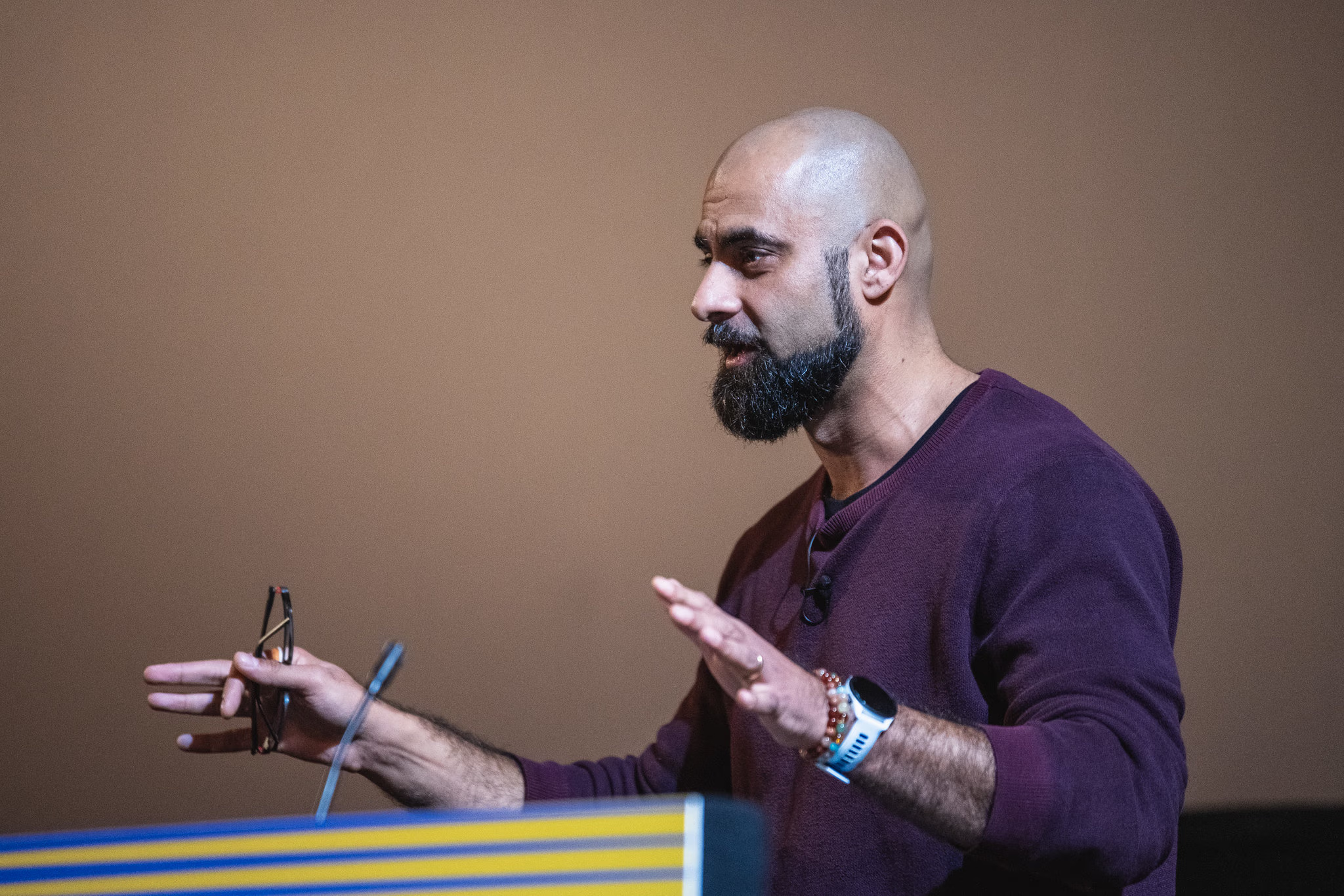
Video
Watch on YouTubeTalk description
Asim connects ancient democratic practices to modern open source and standards, arguing that our most vital work is governance in an AI age—guarding collective decision-making over mere invention.
Session Summary
Asim runs the longest arc in the programme: Eleusinian Mysteries, endogenous DMT, consciousness theory, Athenian democracy, Brexit, and finally AI-assisted deliberative democracy. The brightest minds of antiquity spent two thousand years secretly drinking an ergot-derived psychedelic, came back with a consistent message of unity, and bootstrapped the world's first democracy on the strength of it. That radical version, direct participation with randomly-selected agenda-setters, lost out to the representative model that gave us Brexit. Taiwan's Polis tool proves software can scale Athenian deliberation. The closing etymology lands hard: idiot originally meant a private citizen who refused to deliberate. Don't be one.
View detailed generated session topics, quotes and video timestamps
A journey from 234 BC to AI (1m31s)
Asim Hussain runs the Green Software Foundation, where the day job is helping people agree on standards. He's recently been using AI to help groups find common ground in deeply polarised debates — and the results have been incredible. The rest of the talk takes a long route to get to why.
"I describe myself as somebody who's in the field of getting people to agree on topics"
"we're not the only ones in this polarised world — there is a vibrant field of academia which is exploring how we can use AI to bring people together"
"we're gonna go deep into a few topics that seem pretty out there and unrelated. About halfway through you're gonna be sitting there thinking, 'what the hell is going on?'"
The Eleusinian Mysteries (2m01s)
A walk through the 2000-year Eleusinian Mysteries cult of ancient Athens. Participants — Pythagoras, Plato, Cicero — fasted, bathed, sacrificed, walked a 14-mile pilgrimage and were ritually insulted on the way, then experienced something in the Telesterion they spent the next 2000 years refusing to talk about.
"the Eleusinian Mysteries were like the fight club of antiquity — first rule of the Eleusinian Mysteries is you do not talk about the Eleusinian Mysteries"
"for nearly 2000 years, people kept the secret — not because they had to, but because they wanted to"
"this wasn't some fringe cult — this was the intellectual and spiritual elite of the ancient world"
What they drank, and DMT in your body (5m43s)
Albert Hofmann (the chemist who invented LSD) theorised that the kykeon the initiates drank contained an ergot-derived LSD analogue. LSD belongs to a family of psychedelic compounds, all of them related to serotonin — including DMT, which the human body produces endogenously at the same levels as dopamine and serotonin.
"the chemist was Albert Hofmann, who is the gentleman who invented LSD completely by accident"
"your bodies right now are creating DMT — all of you right now are creating DMT inside your bodies"
"your body does not normally generate chemicals it doesn't need"
Consciousness theory and the message of unity (10m23s)
The strongest evidence that consciousness isn't only an emergent property of biology is the near-death-experience literature — clinically dead patients who later report being conscious during the period, with verifiable details. Analytic idealism proposes there's one universal consciousness that buds off into smaller consciousnesses, and DMT may be the chemical neurotransmitter between them. The message DMT users report is consistently the same — unity, oneness, connectivity.
"Patricia Churchland: 'theories of consciousness are like toothbrushes, everyone has one and no one wants to use anyone else's' — you could replace theories of consciousness with JavaScript frameworks, right"
"spiritual teachings, psychedelic awakenings, all point to the same thing — a sense of oneness, a sense of connectivity emerging with a higher consciousness"
"what happens when, for 2000 years, you have the brightest minds in antiquity take psychedelics?"
Athenian democracy as the message (14m29s)
The thesis the rest of the talk depends on: we wouldn't have democracy without the Eleusinian Mysteries. Athens is both the home of those Mysteries and the birthplace of democracy. The early Athenian version was participatory and deliberative — 30,000 citizens could attend assemblies directly, a randomly-selected council of 500 set the agenda for a single non-renewable year, and the goal was for citizens to deliberate, not to elect representatives.
"the reason we all know about Athens also is that it's the birthplace of democracy — I think they're 100% connected"
"no political class, no professional politicians — the goal wasn't to elect someone to make decisions for you, it was for citizens to come together to deliberate on issues themselves"
"political scientists call the Athenian version of democracy radical democracy"
We have representative, not Athenian, democracy (16m38s)
Modern democracy is representative — we elect MPs and hope. Brexit is the worst possible illustration: the agenda was set externally (leave or stay, with no nuance), and citizens were given the X-in-a-box version of democracy rather than the deliberate-with-each-other version. The real power was always in who set the agenda, and Brexit voters never got that part.
"democracy isn't putting an X in a box and choosing something — there's a huge power in setting the agenda"
"we elect people who deliberate on those issues on our behalf — we hope, dream and pray that they make true on their promises"
"you can brush your teeth before Spidey and his Amazing Friends or after — you've got a choice, you've got a vote, but you're brushing your bloody teeth, right?"
Why the Green Software Foundation made me question democracy (19m14s)
Years of consensus work at the Foundation taught him an uncomfortable truth: sustainability is consistently proven to be a priority, yet very little happens. The fear about AI isn't the technology — it's the absence of trust that governments will act. The conversations we need to have are about fixing our democratic institutions so they can function in the age of AI.
"I've come to realise something pretty uncomfortable — like, it kind of doesn't matter"
"I don't think it's the technology itself we're scared of — it's that we don't trust our governments to protect us from the impact of AI"
"you can have all the brilliant solutions in the world, but if the process of making and executing collective decisions is corrupted, nothing changes"
What digital democracy could look like (22m50s)
Taiwan has been running deliberative digital democracy for a decade through the open-source Polis tool. The Uber question (2016–17) wasn't a yes/no referendum; it was a structured deliberation that produced six citizen-defined preferences that became Taiwanese law. AI now makes it possible to scale this to entire countries.
"they didn't have a referendum — 'yes Uber, no Uber'. They had a whole process where they sat down and figured out what their preferences were, and they came up with these six preferences which then got enacted into laws"
"now with AI in the mix, it's made something possible that will finally enable us to scale out the Athenian democratic model to the size of entire countries"
"AI being used to surface the voices of the people, their fears, their worries, their concerns — and the people decide the preferences, not the politicians"
Brexit, reimagined with deliberative AI (26m02s)
The hypothetical Brexit-with-AI flow: instead of a binary referendum, ask citizens to tell a story about what they're worried about. AI converts the unstructured input to tokens and clusters preferences. New preferences emerge that no traditional questionnaire could ever surface — Asim's bet is that what would have surfaced is the genuine grievance, the 2008 financial crisis and the austerity that followed.
"questionnaires are quite exclusionary — the act demands that you formulate positions and arguments to concrete points, and if you don't have the language to express your idea, you fail to express your point"
"I actually recommend people not even write out their answers — use a voice transcription service and just speak your answer. When we write, we self-edit; when we vocalise it, we tend to give so much more nuance"
"I think Brexit was about the global financial crisis... it was seen as a protest vote — 'I don't know what's going on, I hate this'"
Don't be an idiot (32m17s)
The closing reframe. Democracy is fragile — it took 2000 years and a lot of LSD to convince humans to try it, the Athenian version failed, the representative-democracy version we have now is also under attack from disillusioned citizens who'd genuinely prefer autocracy (El Salvador's 90% approval rating for Bukele is the example). His proposal: fix democracy with AI, don't give up on it. The Greek word idios meant a private citizen who didn't participate in public deliberation — and over time, via Latin, French and English, it turned into idiot.
"we fix it, and AI can hand us the tools to scale true deliberative democracy to everyone"
"I don't think there's a lot of faith that another PM is going to solve the problems we already have — but rather than give up on democracy, my argument is that we fix it"
"idios originally meant just a private individual, then it evolved into meaning someone ignorant of public affairs — across Latin, French and English it turned into the English word idiot. So my message to you today is pretty simple — don't be an idiot"