Forgetting Machines: AI Coding Tools and Skill
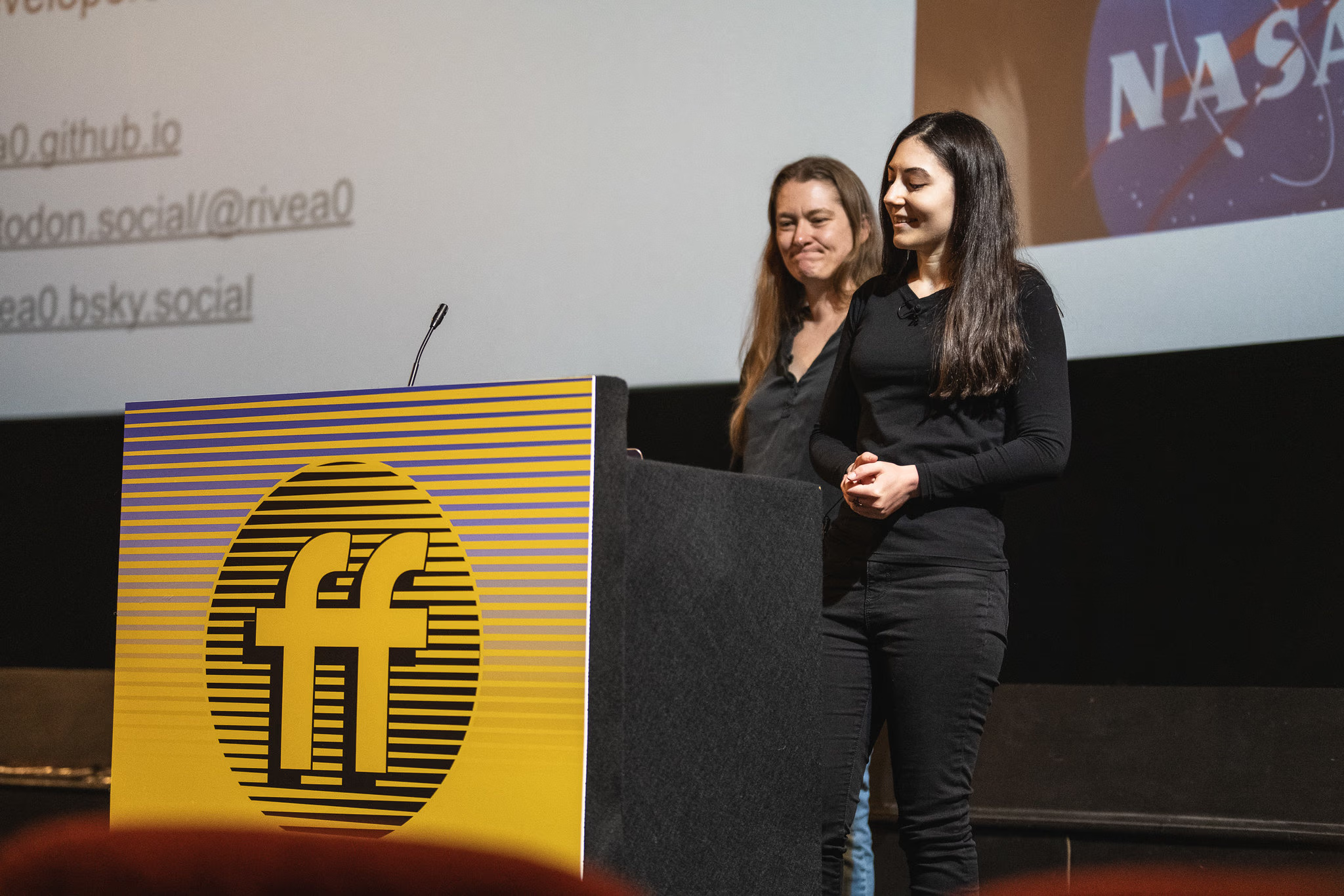
Video
Watch on YouTubeTalk description
Jessica and Eda probe how AI coding tools erode the learning processes that build developer skill, what that means for individuals and the industry, and what we can do to counter the brain drain.
Session Summary
Jess and Eda sidestep the AI shouting match and pose a sharper question: what happens to the next generation of developers when the tools we hand them strip out the very friction that builds skill? Using Barbara Oakley's hedge-maze model of learning and the declarative-versus-procedural divide that explains why 700-day Duolingo streaks teach you nothing, they show how AI coding assistants quietly erode neural pathways at the individual, team and industry level. Then comes the generous part: a practical playbook for learners, managers and the rest of us to slow down, mentor, unionise, and keep the seniors of 2035 from vanishing before they exist.
View detailed generated session topics, quotes and video timestamps
What we're worrying about (3m08s)
Jess (Bad Website Club bootcamp) and Eda (self-taught Rust learner) open by framing the talk's narrow scope: not AI doomerism, not AI evangelism — what is current-generation AI coding tooling doing to skills development, and what will happen if it carries on?
"I'm not an AI doomer, but I am old enough to have been through more than one hype cycle before"
"what impact are these match-hyped AI coding tools having on our skills as developers as they are used now?"
"what we wanted to look at... is the road ahead for newcomers to the industry"
How LLMs generate code, simplified (4m44s)
A deliberately loose definition: collect a dataset, train a model, query the model, get an output. They don't think. They're a very fancy autocorrect — fancy is not damning with faint praise, they are extraordinarily fancy — but their output is what they've seen associated with this query in the past.
"the LLMs that produce code are then doing is they're going to give you some output based on what they think — and I want to be super clear that they don't think"
"I like to compare this to a really fancy autocorrect — and this isn't damning with faint praise"
"there's no thinking. They're telling you, based on other stuff I've seen in my dataset, you might want this"
How learning actually works (6m50s)
Drawing on Barbara Oakley's neuroscience-of-learning research and Zach Caceres's work on learning to program: learning is new neural pathways built by pushing through the equivalent of a hedge maze, and the pathways are strengthened by repeated practice. The friction of pushing through the bushes is the learning.
"learning happens when new neural pathways in our mind are built, and when existing pathways are strengthened through use"
"I like to think of this as a hedge maze, where the new things we learn are like us pushing through the bushes to make our own new paths"
"pushing through a hedge maze — that first part of establishing a new neural pathway — usually involves a little friction to build it"
Declarative vs procedural knowledge (8m20s)
Two kinds of knowing. Declarative: you can describe it. Procedural: you can use it intuitively, like cycling. Duolingo is the cautionary tale — 700 days of daily study can produce a lot of declarative knowledge of a language and zero procedural fluency.
"you can have declarative learning that never really hits into procedural learning"
"procedural learning is when you learn a task or craft deeply, and are able to draw on your skills in that task to do impressive things without needing to consciously recall knowledge"
"Duolingo is trash"
AI cuts away the friction we need (10m24s)
The core argument: AI coding tools abstract away the friction that builds neural pathways. Asking the AI for the function is using somebody else's path through the hedge maze. You never built your own. The output is also necessarily constrained by what the AI has seen — common is right is fine for the common cases, but it falls over on legacy code, complex domains, edge cases, and the esoteric programming languages the AI has no data on (Befunge's 2D infinite loops, the Shakespeare Programming Language whose hello-world is Speak your mind, you're as bad as Hamlet).
"if I ask the AI tool, 'make me a function that does this', it's just going to give me the answer right now — you don't need to push through this hedge maze"
"this is taking away the friction to push through these bits of hedge to start building new pathways and deeper understanding"
"AI can't replace developers with these languages, because there's not a lot of training data on them — it makes them very hard to be easily generated by an AI model"
What this does to teams and projects (14m04s)
A team's available skills are the sum of its members' skills. If every individual is offloading their learning to AI, the team accumulates a sediment of missing knowledge. AI tools are great at quick prototypes — and prototype-shaped code doesn't scale, doesn't connect, and doesn't maintain. Worse, AI-generated code you didn't struggle to write is code you have no functional memory of — much harder to come back to in six months.
"at no point will the skill sets available in your team be more than the skill sets available in your individual team members"
"if you didn't write this code — if the answer was given to you out of the ether — you don't have the pathways built by struggling. You have code that you have no functional memory of"
"if we get really, really used to turning these out as prototypes, we're gonna have a real hard time going back to non-prototypes"
What it does to the whole industry (18m10s)
The same dynamic at scale. The industry has talked about skills gaps for years; AI-driven acquisition gives us a faster, more automated way to widen them. AI tooling is expensive, so adoption is uneven, geographically and economically. And the we don't need to hire juniors any more, our AI replaces them discourse from CEOs and middle managers means we systematically stop developing the next generation — and create a fear culture in which seniors and mid-weights are also told they're replaceable.
"we talk all the time about skills gaps in the tech industry at large — this is giving us a really fun, really automated way to make this scarier faster"
"the same time as CEOs are touting the efficiency and their investment in these tools, they're running layoffs"
"industry-wide, and as individuals, we learn best when we're not scared"
What you can do as a learner (23m27s)
Compensate for the abstraction the tools provide by being deliberate about your own learning. Formal courses if you can afford them. Silly or serious side projects. Read a lot. Keep a learning journal, write blog posts about what you're learning. Code-exercise habits (Jess admits she has never managed to stick to one). And, crucially, slow down when you use these tools — actually read what they output before you ship it.
"be more present — not just surrender yourself to an autonomous agent and let it take the wheel"
"it's really tempting to be given the answer and say, 'haha, I'm out'"
"this might work — is this actually what I need? — is not just good learning, but also probably going to make your life a lot easier for code quality"
What managers and the rest of us can do (26m33s)
For managers: build learning time into your timelines, do code reviews that check for understanding (walk me through why you chose to do it this way), make space for skill-sharing while seniors still have the pre-AI skillset, and spend the company's training budget. For everyone else: teach and mentor, support emerging talent, join a union, build the kind of safety where people can learn without being afraid. Computers were a mistake.
"the good news is if you're a manager, you have a tonne of space to really impact the impact of these tools on your team skills development — the bad news is it's also your responsibility"
"right now, we've still got seniors around who built these skills before these tools came around — corner them while you can, make them share"
"build up conditions where folks can make you a little bit less afraid, and things will be a little bit less bad"
About Jessica Rose & Eda Eren
Jessica: I woke up one day and realized that programming languages are like human languages, but with jobs that paid better and wouldn't make me get a PhD so here I am. Eda: I had an epiphany once that technology is not supposed to be a curse, and programming can be seen as an art form, not just pure science. (Also, that there's always lots to learn, so that's what I decided to do!)