Death, and how tech forgot about mortality
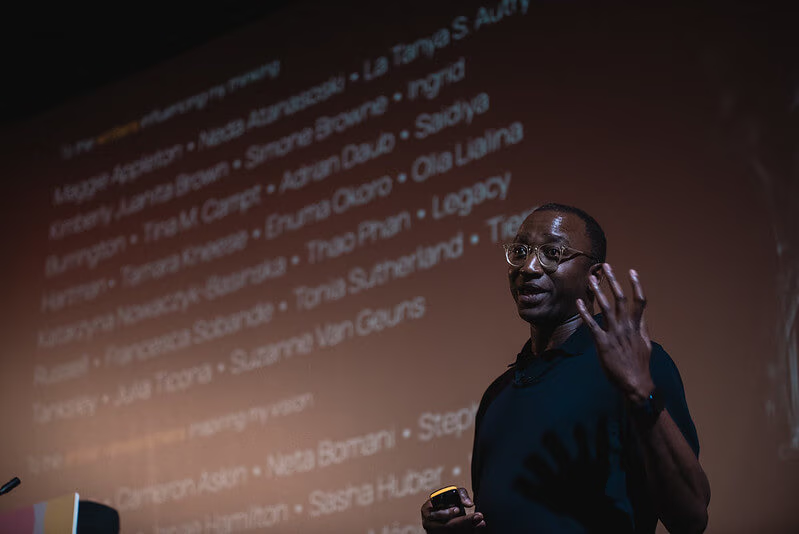
Video
Watch on YouTubeTalk description
How death is not only a concern for individuals and their digital remains, but rather it exposes how the technology companies that safeguard our data are more likely to "die" before we do. So, what happens then?
Session Summary
The Falsehoods Programmers Believe tradition gets applied to the subject the tech industry has structurally refused to engage with: what happens to data, platforms and infrastructure when a user dies. Three categories, six falsehoods, each paired with a current case study. Most adults don't have a will. Grief-tech is a hundred-billion-dollar industry already reanimating the dead. Twitter tried to purge inactive accounts and discovered the dead were among them. Bebo died twice, bit rot is structural, and the cloud is just buildings full of fans. The closing image of Renty and Delia, trapped in the architecture of an 1850s photographic frame, lands the case that digital existence can imprison and we are the architects.
View detailed generated session topics, quotes and video timestamps
Falsehoods and what this talk is for (5m42s)
The speaker opens with the Awesome Falsehoods reading list and the Falsehoods Programmers Believe About Names tradition. A falsehood is an incorrect-but-deeply-held assumption that quietly guides your work. This talk catalogues the falsehoods our digital systems hold about death.
"a falsehood basically is an incorrect idea that you believe that persistently guides your thinking, and they're very, very difficult to spot"
"what could be more simple than creating a registration form? First name, last name, email address — easy"
"the more you look at falsehoods, they can start to become contradictory as well — all of a sudden, something that you think is so simple to present in a digital system, you start to introduce this concept of falsehoods"
Personhood: there is no neat journey (8m51s)
The naïve service-design view of death assumes a will, a legal process, and clear distribution. The reality: up to 60% of UK adults don't have a will, and even those who do aren't operating logically in the period after a loss. Falsehood: most of us have a plan for our death.
"we design services on the assumption that there's a neat path that people will follow"
"up to three in five of UK adults have not made a will"
"in a time of great distress, you're not going to be thinking logically, methodically, and following a one-two-three step process"
Digital selves are not consistent (10m53s)
A person exists across many platforms, in three modes — public, private and secret — and the secret mode matters as much as the public one for journalists, activists, queer people in unsafe jurisdictions, and survivors of domestic abuse. Falsehood: our digital selves are consistent. Inheritance frameworks built for physical assets cannot map onto this.
"who decides the ownership of a public profile? Some social media profiles have tens of thousands of followers"
"many things that I would put in my private notes, I don't want anyone else to see"
"across many parts of the world, if you are in an authoritarian regime, journalists, activists, political dissidents need to have certain aspects of their identity very, very secret"
Death doesn't end your digital existence (12m58s)
The hologram of Tupac at Coachella 2012 needed a team and a budget. Grief tech — Here After, Replika AI, Seance.ai, MyHeritage — has now dropped the price to a few clicks. The market is estimated at $100bn. Falsehood: death ends our digital existence. Private companies are technologically reanimating the dead, and the question is whether they should be.
"we may think our digital existence ends when our life ends, but the reality is now we're not living in the world of Tupac, Coachella 2012, who needed a team to fill this room"
"with a few clicks and a little transaction, you can have something running on your phone with very little effort"
"this life that has been extinguished is just trapped in this digital vacuum on a loop"
Platforms have no civic obligation (18m42s)
Twitter implodes. Bebo died twice. Platforms describe themselves as the public town square but they're privately-owned corporations with no civic or moral duty to you. Falsehood: platforms are obliged to provide us a service.
"these are private corporations acting for the benefit and interest of their shareholders"
"Bebo, the social network that was so terrible it died twice"
"with a few bad business decisions or a few wrong turns, the actual whole company just imploded"
Not all your users are alive (20m13s)
Twitter once announced it would purge inactive accounts; the backlash that those accounts belong to people who have died forced a reversal. Falsehood: all users are alive. Tamara Kneese's Death Glitch documents how platforms only design value-models for living, breathing users — and the cost is paid by the bereaved.
"in the eyes of the corporation, the active account is a productive account... but for that very binary understanding of value, when the account's inactive it's no longer useful"
"just because an account exists, it doesn't mean that the person is alive"
"if you're a service, product or platform designer, my challenge is to think about your users not in terms of them living, but also in terms of them being dead"
The internet is materially decaying (23m25s)
The cloud is cables, discs, fans, hard drives, and buildings. Bit rot — the decay of electromagnetic charge over time — affects every storage medium, and the Internet Archive's Wayback Machine and the Flickr Foundation are doing the unloved work of trying to keep things readable for a century. Falsehood: if our data is saved, it's safe.
"in this cloud era, the internet is still made up of cables and discs and hard drives, routers and servers, fans and moving parts"
"bit rot is a really big problem if you're working in infrastructure of technology and storage"
"the fabric of our digital selves is in constant decay"
Three questions for Monday morning (29m37s)
The practical action: take each of the three falsehood-categories back to your team. Person: what is our service's role when a user dies? Platform: how will users get their data if our service ends? Pieces: will users' data be accessible 50 years from now?
"what is our service's role when a user dies? This is not asked enough"
"how will users get their data if our service ends?"
"will users' data be accessible 50 years from now? This is such a short period of time when you look at the whole history of humanity"
Renty, Delia, and the architecture of the photographic frame (31m41s)
The closing image: Sasha Huber's Tailoring Freedom, an artwork made from the staples used to repair the dignity of Renty and Delia Taylor — enslaved father and daughter photographed in 1850 under racist coercion. The original photos are still held by Harvard. Their descendant Tamara Lanier is still in court to get them back. Legacy Russell's Black Meme names what the talk has been circling: digital existence can imprison, and we built that prison.
"Renty and Delia are forever trapped in the architecture of their photographic frame, now transformed into an infinitely scrolling browser tab"
"we don't need to accept the destiny of being trapped in an infinitely scrolling browser tab, AI-generated or otherwise"
"how death can embrace mortality"