The art of reflection
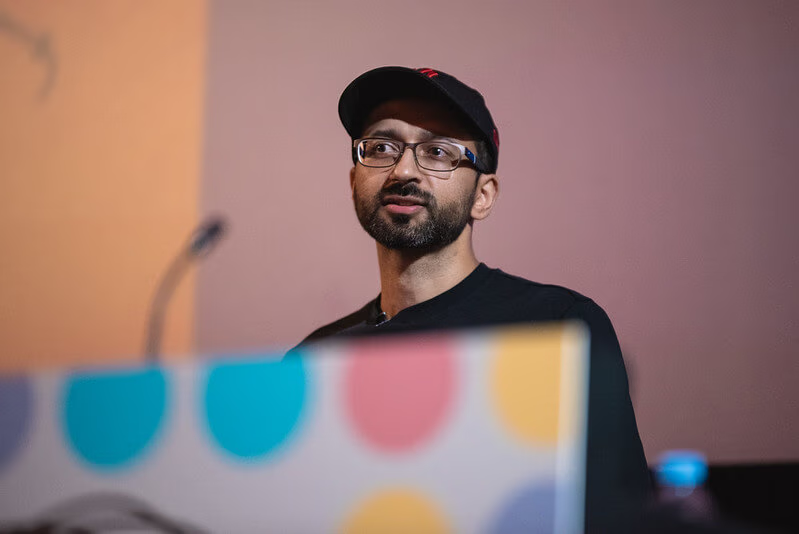
Video
Watch on YouTubeTalk description
Art and design require imagination, yet in our busy lives, we often neglect reflection, which is essential for self-growth and long-term success; Imran's talk will explore how taking time to reflect can help us learn from our experiences and shape a better future.
Session Summary
A wrongly-accused ten-year-old spends a month alone at school break-times with only his thoughts, and decades later that same journey inwards becomes Imran's quiet thesis: empathy starts with self-empathy. We fill out empathy maps for end users and never one for ourselves, then wonder why the products feel hollow. The argument lands on a small, doable commitment of fifteen minutes a day, the Gibbs reflective model with feelings as a first-class stage, and three practices, solitude, curiosity, imagination. The father's line, having more time doesn't mean you should do more, carries it. Change begins with you.
View detailed generated session topics, quotes and video timestamps
How well do you know yourself (2m43s)
Imran opens with the question the whole talk circles around: how well do you know yourself? The mystery of life isn't a problem to solve, it's a reality to experience — and the work the audience does makes it easy to keep solving the next puzzle without ever asking why.
"the mystery of life isn't a problem to solve, but a reality to experience"
"have we chosen to neglect the greatest mystery of all?"
"are we so busy doing things that we don't have the time to stop and think and understand why we're even doing them in the first place?"
A baseball cap and the journey inwards (3m47s)
A formative childhood story: aged ten, wrongly accused of flushing a classmate's baseball cap down a school toilet, he spent a month of breaks and lunches alone with his thoughts. His parents' advice — maybe you can't fix this, but you can come to terms with the experience — eventually sent him to art, which is fundamentally about looking inwards.
"for the record, I didn't do it. Honestly. I'm not just saying that, I didn't do it"
"maybe I can't fix this, maybe I can't make it better — but perhaps I can come to terms with the experience"
"art is all about the journey inwards"
Having more time doesn't mean you should do more (6m30s)
His father's most-used piece of advice. He didn't understand it until after his father died and he finally had the time to stop and think — by which point he had run out of time with his father. The reality: time is always working against us; we fill it; meetings, roadmaps, devices in pockets and now on wrists and in cars are all aligned to make us do more.
"having more time doesn't mean you should do more"
"I'd actually run out of time with my dad"
"we now spend most of our time fiddling with touchscreens... [the device] suddenly you're doing more now, being followed by those devices"
Empathy starts with self-empathy (10m47s)
In tech we pile on tools and frameworks and AI; meanwhile Aristotle's knowing yourself is the beginning of all wisdom sits unaddressed. We fill out empathy maps for end users without ever filling one out for ourselves — and the first step to empathy with anyone else is empathy with yourself.
"if we can't practise empathy for ourselves, how are we going to practise empathy for other people?"
"the first step to empathy is self-empathy"
"we need to understand ourselves better so that we can understand others better"
Reflection as a cycle (13m04s)
Reflection runs anti-clockwise: experience → reflect → learn → apply to the next iteration. Fifteen minutes a day, according to the experimental data, makes people more productive, happier, and less burnt-out. The people who excel in their fields are not the ones who do more — they're the ones who are intentional about less.
"reflection begins by looking back — we need to be able to look back to understand the past so that we can truly shape the future"
"the people that actually took the time to reflect at the end of the day were more productive, happier, and less burnt out"
"the people that are truly successful and feeling fulfilled are the ones that do less"
Meaning comes from feelings (16m07s)
Professor Graham Gibbs's 1980s model of reflective practice was the only major one that included feelings as a stage — feelings get dismissed in working culture as a sign of weakness when in fact they're a sign of courage. At the Co-op, Imran's team retrospectives spend deliberate time on how everyone felt over the quarter and how those feelings differed across people.
"it's easy to forget what someone says, but rare is it that we forget how someone makes us feel"
"feelings are neglected by our society — they're seen as a sign of weakness, when in reality they are a sign of courage"
"I can't tell you the value of doing an exercise such as this — for people to pause for a moment and to think about how they feel and how that impacts their work and everything else"
Reflection is an art: solitude, curiosity, imagination (18m44s)
Three practices. Solitude: 15 minutes a day alone, no phone, no watch, no device — let the leaves of your thoughts fall where they fall. Curiosity: when something didn't feel right at work, don't just inventory the actions and behaviours, dig down into what was driving the person, what motivated the behaviour, what's the belief underneath. Imagination: revisit your journal entries from a few days ago, observe how your perspective has shifted, and imagine a different version of the experience.
"imagine your thoughts being leaves falling from a tree — leaves will fall and land where they need to, and your thoughts are no different"
"we need to dig through the layers — what's driving someone, what's the motivation behind someone doing something"
"don't simply read your journal — go back to it after a few days and revise your notes"
What reflection has done for me (26m08s)
Concrete changes from the practice: improved self-awareness (knowing his strengths and where he needs other people), deeper alignment with his values (only saying yes to things that match them), more perspectives on a situation when designing for someone else, and an embrace of iteration — this is the fourth version of the talk, and he expects there to be more.
"I know my strengths and weaknesses — I know how I can help people, but at the same time, I recognise when I need to lean on other people"
"I don't say yes to everything — I only say yes to those things that I know align with my deepest values"
"I'm quite confident this won't be the last iteration of this talk"
Change begins with you (28m22s)
The closing return to the opening question. Our industry's job is to make the world more accessible, inclusive and humane — and that journey doesn't begin with the end user, it begins with you. The greatest mystery isn't out there; it's inside each of us; reflection is how we explore it.
"the greatest mystery is not something out there — the greatest mystery of all is inside all of us"
"if we can't take the time and find the courage to change who we are, how can we possibly bring about change in this world?"
"change begins with you"
About Imran Afzal
As a kid, I was often told by teachers and friends that I could start a cult. I'm an adult now, and people are still telling me the same. Maybe I will start that cult.