Code Calligrams
Audio
DownloadVideo
Watch on YouTubeTalk description
Programming is art: It is like painting, but instead of drawing on a canvas we populate computer screens with colours. And rather than using brushes, we combine bits and bytes to trace an ever-changing flow of images.
In this talk, you'll be introduced to the art of "Creative Coding" and how to generate beautiful new worlds, using nothing else than the languages of the Web.
Session Summary
Martin Kleppe writes JavaScript that doubles as visual art, and each demo strips away another thing you thought you needed. The whole talk reads like a magic act: lose multiple files, lose ASCII, lose the Latin alphabet, lose visible characters, lose kilobytes, and somehow a spinning 3D globe still renders, a Game of Life still ticks inside a Hebrew aleph, and the Mona Lisa still loads from 244 bytes. The technical heart is a walkthrough of writing executable JS using hex escapes, octal sequences, Function constructors and zero-width control characters. The takeaway is sharper than any tip: pick a constraint nobody asked for, then make it smaller.
View detailed generated session topics, quotes and video timestamps
The t-shirt riddle (0m29s)
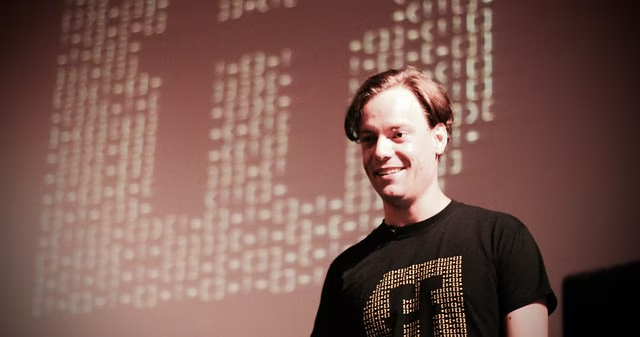
Martin opens by walking through the three Full Frontal t-shirt designs he sent Remy — each version of the conference logo is actually executable JavaScript, with the final attempt written entirely in six characters of JSFuck.
"I'm trying to pack code in a shape... I took the Full Frontal logo and tried to like make it executable by placing symbols in there"
"this is actually like JavaScript code that you can execute"
"it uses only like six different characters... to write JavaScript and you can actually execute all of the examples"
What code calligrams are (3m38s)
He defines code golf — solving a programming problem in as few characters as possible — and the related practice of code calligrams: arranging code into a meaningful shape so that the source itself is also an image.
"code golfing is like a kind of sport where you try to solve a programming problem in a shortest amount of characters"
"a calligram is usually something drawn or like written and it has a nice shape and also like a kind of picture"
"it's a mix of picture, words and like type"
Quines and code that draws itself (4m42s)
A quine is a program that prints its own source code, and Martin shows two: a block of JavaScript whose comments form a 3D globe that then spins inside the rendered page, and the "M-code" fractal that zooms until JavaScript's float precision falls apart.
"a quine is a program that will output its own source code"
"you have a spinning 3D globe that rotates inside of this code... no external libraries, no external resources"
"it zooms in into this fractal until like a point where the resolution or like the float precision of JavaScript is not enough anymore"
JSFuck and the six-character JavaScript (6m45s)
The JSFuck project answers an old forum question — what is the smallest set of characters needed to write any JavaScript? — with ()[]+!, and Martin's jsfuck.com tool turns any source into a runnable string of those six symbols.
"how many different symbols do I need in JavaScript to execute any code that you like"
"you only have to use brackets, plus sign, square brackets... it's parenthesis, plus sign, square brackets"
"there's no need for other transpilers or stuff, so it's valid JavaScript that executes"
Writing code in other alphabets (7m46s)
For conferences in Russia, Israel, Japan and Singapore he made HTML pages whose entire <script> is written in Cyrillic, Hebrew (right-to-left source code, like the rendered text), Katakana, or a Matrix-style rain of mixed Asian alphabets.
"it's only using like Cyrillic letters and... a special Unicode in the middle, the star"
"in Hebrew... it's written from right to left, and not as we used to from left to right"
"the question for you would be: how the hell do I write JavaScript without Latin characters?"
How to write JavaScript without Latin (10m54s)
The trick has two halves. Unicode and hex escape sequences (a, \x61) let you swap any letter for its codepoint inside a string; octal escapes (\141) survive nearly anywhere except ES2015 template literals; and [].map.constructor recovers a Function constructor you can call as a quiet replacement for eval.
"back slash u and then it has a four-digit hexadecimal code for the character"
"this is called the octal escaping... just a backslash and a sequence of numbers from zero to seven"
"if you have a function and get a constructor, then you get back like a function constructor... it's kind of a replacement for eval"
Invisible code with control characters (18m38s)
Stripping the trick further, he hides programs inside a one-line HTML file where the apparently-empty string contains C0 device-control characters that take up zero visual width, then decodes them at runtime with escape().replace() and \x prefixes.
"the idea was quite simple... using whitespace... but the problem is that it still takes up some space"
"the device control characters... are not visible at all because they have no width"
"the real Game of Life that's behind, it's only 25 characters"
Combining characters and Mona Lisa in 500 bytes (23m52s)
For an Israeli conference he hid an entire program inside two stacked aleph characters using Unicode combining marks that overlap rather than stack; for Singapore he compressed the Mona Lisa to a 244-byte WebP, then wrapped an HTML page that loads itself as an image so the page-as-document and page-as-bitmap share the same bytes.
"they are called chants... they don't take up space, they're still visible, but you can like overlap them"
"the ALF is the one symbol that contains all other letters or all other numbers, and I was able to put everything in one place"
"this HTML page has an image that loads the HTML page as the image source"
A 168-byte Star Wars and a JS calligram of the FFConf logo (31m32s)
Inspired by a 3KB starfield demo, he rebuilds the whole effect — CSS translate3d perspective, animation and all — into 168 bytes, then reshapes its source into the Full Frontal logo so the code is a quine of its own silhouette.
"I came up with is this... it's 168 bytes... full HTML page with all things"
"this is the [ie-style] DOCTYPE thing — bgcolor zero makes it black and text will define the text color"
"it will not actually a quine because it doesn't show its own source, but it shows its own shape"
Why do this? (35m10s)
The justification is creativity under constraint: setting a byte limit forces you deeper into the language, the constraint is self-imposed rather than client-driven, and the focus required to fit an idea into 1K is exactly the focus most useful in everyday work.
"it forces you to go over the limits that you're used to"
"you have to learn the language and discover new parts and you have to use your curiosity"
"if I want to create a project and finish a project I have to focus on the most important task to get it done"