Abstract art in a time of minification
Audio
DownloadVideo
Watch on YouTubeTalk description
aesthetic is a major component of any medium for art, including the web, but one thing that has been bothering me lately is: what happened to "view source"? are we destroying aesthetic for the sake of tooling and in spite of access to our industry????¿¿¿¿
Session Summary
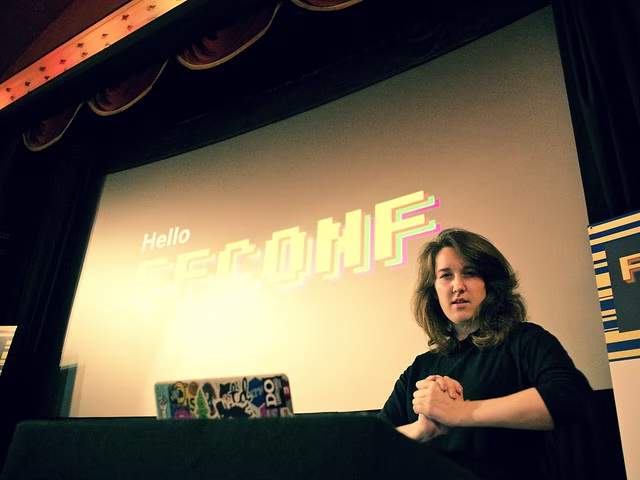
Jenn Schiffer opens warmly with pixel art and Glitch, both about lowering the bar to making things, then pivots into the harder talk she has wanted to give for years. She pairs the art world with the tech world relentlessly: a stolen Vermeer beside a deleted Vine, a Whitney Biennial appropriation beside Bodega, a lost CD-ROM archive beside the deploy script that took Gothamist down the week its staff unionised. The view source tradition is dying, accessibility is dismissed in the same breath as we claim heroic work, and sentencing algorithms train on human-error data. The closer hits hard — what is your legacy if today is your last day shipping?
View detailed generated session topics, quotes and video timestamps
Pixel art lowers the bar to expression (1m01s)
Jenn Schiffer opens with her parallel career as a pixel artist, arguing that pixel art's abstraction is exactly what made it possible for her to express herself without having to be photo-realistically "good enough" — much like programming.
"with pixel art it only takes a little bit of data — in this case about a thousand pixels in six colours — and it goes a long way in conveying human emotion"
"pixel art allowed me, from a young age, to express myself without feeling like I'm not 'good' enough"
"it lowers the barrier to artistic expression while at the same time evoking nostalgia in a fun and positive way"
Glitch, and the unsavoury parallels (2m34s)
She works on Glitch at Fog Creek, a collaborative in-browser editor whose stated value — lower the barrier to building things — is the same one she chose pixel art for. But the rest of the talk is about the unsavoury parallels between making art and making tech that she'd rather see the industry talk about.
"we describe Glitch as a friendly community where you'll build the app of your dreams"
"Glitch is very similar to pixel art... it lowers the barrier to expression, while invoking nostalgia in a fun and positive way"
"I'm tired of being known as 'the woman who hates blood parabiosis' — I want to tell you about those unsavoury parallels, because I feel like more of us building tech need to do the same"
What happened to View Source (9m15s)
Geocities, MySpace and AngelFire let her learn HTML by reading other people's pages. Build processes, minification and the rebranding of "view source" as "developer tools" have raised that barrier — and the source-maps story is honest fiction.
"what about people who are afraid to call themselves developers? What if people see 'developer' and think that they're possibly going to break the browser?"
"who here actually has set up source maps with every project that they've worked on? If you're saying you have, you're probably lying"
"we want the web to be open. Well, Verizon doesn't think so, but fuck them"
Ephemerality: from Vermeers to Vines (12m22s)
A Vermeer stolen from the Isabella Gardner Museum still hangs in absentia in its empty frame; the Les Secrets artwork survives only on a CD-ROM after French conservatives forced its database offline; Vine's shutdown vaporised 197 of her 200 clips along with a generation of comedy.
"this in part keeps the artwork alive even in its actual absence — so can we do that with technology?"
"the database was lost, so the code for the website remains on a CD-ROM... so this is literally all that remains"
"with the decision of Twitter to shut down Vine, content from all over the world, all different cultures... is just gone"
Don't be naive about who gets to shut things down (15m28s)
Gothamist, DNAinfo and their sister sites were nuked the week their staff voted to unionise; the goodbye page was lifted from a Stack Exchange snippet with the variable adios left in the markup. The lesson is for whoever wrote the deploy: when a rich man says do it or lose your job, you're probably losing it either way.
"my worry is that there's some engineer out there who thought it was okay to take the orders to make that happen"
"I viewed the source of the letter... and I discovered that the person who did it just copied and pasted the code from a Stack Exchange answer"
"if you're going to naively think that your career is safe, you just have to make a tough decision as to whether you're going to say 'no' and take a stand"
Ownership, theft and patent trolls (19m04s)
Theft of small artists' work by retail giants happens routinely; patent trolls go after small shops for things like using image maps because most companies can't afford to fight. Open-source licences are similarly opaque, and most engineers, herself included, cannot tell you what MIT or GPL actually obligate them to do.
"if a patent troll goes to your small five-person consulting agency, and you don't have a huge platform in the community... you're gonna go to court, they're going to ask you to settle"
"most of us in this room, we can say 'GPL, MIT', but we don't know what any of those things actually mean, or what our rights are"
"ownership is hard and impossible to claim and prove when you don't have representation in your communities to back you up"
Representation: the Whitney Biennial and Bodega (22m41s)
Dana Schutz's painting of Emmett Till in an open casket hung at the 2017 Whitney Biennial under protest; Mark Zuckerberg's VR cartoon avatar high-fived over Puerto Rico's hurricane wreckage. The tech parallel: the Bodega startup founders, two ex-Googlers, branded their take down mom-and-pop shops product with a cat logo and an appropriated Hispanic name.
"art can be a space for empathy — which is what I feel like a lot of people of privilege, in essence, white people, say when they've screwed up"
"if you squint your eyes you can probably see the space for empathy between their two hands about to meet in a high-five"
"they did appropriate a Hispanic word and idea of a community-tied business, run primarily by people of colour... more people are concerned about the cats"
Tech debt for problems we invented (27m27s)
While the industry spends VC money imagining problems for people who don't want them solved, we claim accessibility is too hard — refusing to use a <button> because it's slightly harder to style. Everyone on the team is busy enough to skip the work that would help marginalised users the most.
"you will argue yourself a mile around the block a hundred times to avoid using the button element"
"in the same breath we take to say 'accessibility's hard', we will talk about how important all the work that we are doing is"
"we're making tech debt for people we think we can solve problems for, instead of listening to them about the problems they have"
Algorithms can't run the adversity cycle (29m31s)
LaMonte McIntyre was just freed after twenty-three wrongful-conviction years — human error. Sentencing algorithms are now being trained on the records of the same human-error system. The only thing computers can do better than humans is go faster; sentencing is not a speed problem.
"computers don't do things better — they do things faster"
"every day we see new ads popping up for services using artificial intelligence when really they mean machine learning"
"imagine — or look at the real world — that there's a white supremacist society, us, designing algorithms to do their work for them"
What's your legacy (33m36s)
Closing with Robyn Kanner's challenge: look at your last twenty tweets, your last commit, the product you ship — what would your legacy be if you stopped today? Stop fucking stealing, learn how to apologise, accept your privilege, widen your network, and remember that new developers are watching us learn how to be engineers.
"I'm going to die some day, and it could be any time... what is your legacy going to be?"
"new developers are following us on Twitter, on Facebook, they're seeing our conference talks, and they're learning how to socialise and be an engineer by seeing how we interact"
"stop creating monsters and start being actual role models ourselves"