Programming with Yarn
Audio
DownloadVideo
Watch on YouTubeTalk description
Crochet and other yarn crafts can be viewed as a form of programming. Without realising it, crocheters interpret their own patterns, thus becoming "computers". This talk explores the analogies between a craft and what we know of programming.
Session Summary
Crochet isn't like programming, it is programming, and this talk defends that claim with surprising rigour. Lily traces a real lineage from Mademoiselle Riego's reverse-engineerable stitched samples through Jacquard's punch cards to Ada Lovelace's analytical engine, then drops developer-grade rhymes that actually work: managing two yarn strands is literal multi-threading, thread chicken is a race condition, blocking a panel matches blocking a thread, weaving in the ends is your lorem-ipsum check. She crochets live while interpreting a pattern at runtime, then flips the whole talk: programming is what crocheters have always done.
View detailed generated session topics, quotes and video timestamps
Crochet is hidden programming (0m34s)
Lily Madar, software engineer and crochet crafter, opens with the observation that started the talk: as she made flower after flower from instructions, she realised she was doing a computer's job — running an algorithm, parsing a programming language — just with yarn and a hook instead of CPU and RAM.
"I was basically doing a computer's job, passing instructions at runtime and following an algorithm"
"crochet and all the yarn crafts more broadly were maybe a form of programming hidden in plain sight"
"tech, after all, is more about people than computers"
Open-source crochet and Mademoiselle Riego (4m10s)
Mademoiselle Riego, an Irish lace and crochet pioneer, published dozens of pattern books from a young age in the 19th century — but because crochet terms hadn't been standardised yet, the books contained actual stitched samples. People reproduced and modified those samples the way developers fork a repo today. Ravelry is the modern GitHub-equivalent.
"she was a pioneer in open source. Open-source crochet, of course"
"people would easily reproduce and amend those patterns, a bit like reverse-engineering them by exploring the source code"
"in Ireland, it's said that you leave a bit of your soul trapped in everything you crochet — so to avoid this, you should always work a hidden mistake so that your soul can escape... it sounds very much like the all-too-familiar 'this is a feature, not a bug'"
Jacquard looms, punch cards and Ada Lovelace (7m15s)
Jacques de Vaucanson designed a punch-card system for weaving in 1745. The Jacquard loom (1801) used it. Ada Lovelace and Charles Babbage's analytical engine (1842) borrowed both the punch cards and the textile terminology — yarns brought to the store from the mill became numbers brought to the store from the arithmetic mill.
"the analytical engine weaves algebraic patterns just as the Jacquard loom weaves flowers and leaves"
"in textile, the yarns are brought to the store from the mill, where they're woven into fabrics... in the analytical engine, it isn't yarn but numbers"
"Mademoiselle Riego created crochet patterns to be computed by humans"
What counts as crochet software (11m01s)
If software is the programs and information used by computers, and crocheters are human computers, then crochet patterns are software — self-replicating information passed from one crocheter to the next. Early crochet stitches were simple enough to become muscle memory, so people could crochet while talking, praying, travelling — automation in human computers.
"there is such thing as crochet software"
"people would start crocheting while talking, praying, travelling, eating... so there is a form of automation in both mechanical and human computers"
"today, we see a multiplication of code clubs, Women Who Code initiatives, spreading coding techniques far and wide"
Stitches as the standard library (12m35s)
The basic stitches are the language primitives, and they were finally standardised in the UK in 1950 — except a UK double crochet is a US single crochet and a US double crochet is a UK treble, so the same identifier means different operations across dialects. The symbol charts that crochet patterns now use are effectively the universal IR.
"no matter how complex the crochet stitch, it always starts with one loop on the hook and ends with one"
"fundamentally different stitches can share the same name in distinct languages"
"each symbol on this chart will correspond to the same stitch for you to crochet — no matter what language you speak"
A live crochet demo as a human compiler (16m12s)
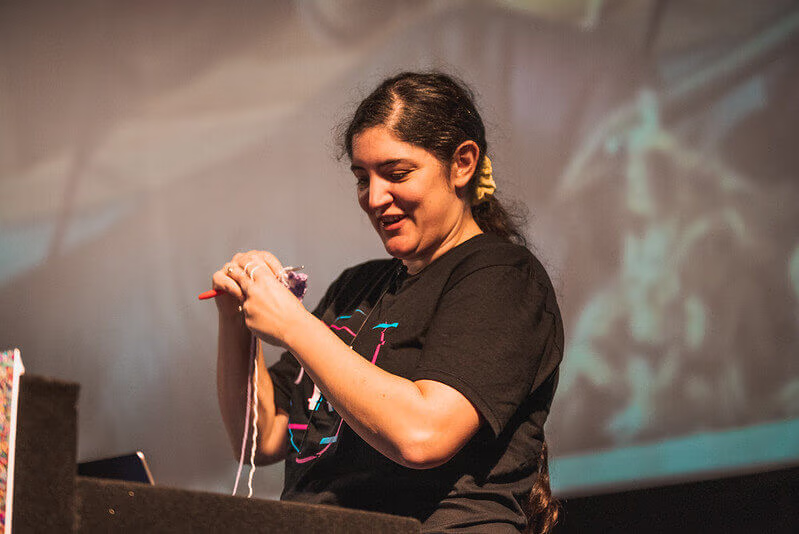
She crochets on stage, reading the pattern from her screen as a "human computer with a compiler in my hand". Colour changes mean handling two yarn strands at once — literal multi-threading. Running out of yarn before the colour change is thread chicken. Mis-counting is a race condition.
"I'm a human computer with a compiler in my hand, interpreting a pattern at runtime"
"as I come to a change of colour in the pattern, I will have to deal with literal multi-threading"
"I can sometimes encounter race conditions, either if I run out of yarn before I'm done using it — that's also known as thread chicken — or if my mind jumps ahead and I miscount"
Debugging and weaving in the ends (17m44s)
Blocking in software suspends a thread; blocking in yarn crafts fixes a finished panel to the right shape and size. You debug by stepping through row by row, pulling out incorrect rows is cheap, and the mandatory post-production step is weaving in the ends — without it, your work is in beta.
"the only acceptable form of blocked chain is with yarn"
"you can put break points and step through your code — meaning you can wait until the next row to see if things align properly"
"if you haven't done [the weaving-in], it's a bit as if you've left lorem ipsum in your content and hit publish"
Hacking with yarn (19m16s)
Yarn crafts have been a hacker medium for centuries — Phyllis Latour hid coded messages in her knitting as a British secret agent in WWII (and is now 101). Eden Cottage Yarns made a cardigan with a Morse-code message in tribute to Bletchley Park's human computers. Google's Project Jacquard turned woven fabric into a capacitive touch interface.
"Phyllis Latour... used her knitting needles to hide coded messages she sent from Normandy during World War II — and she turned 101 last year"
"yarn crafters have been experimenting with cryptography, hiding secret codes and messages in their items from very early on"
"Google and their Project Jacquard transform woven fabric into a touch interface"
Pixel patterns and accessibility (22m48s)
She built her own pattern-generator app for corner-to-corner crochet because the manual stitch-by-stitch counting was the bottleneck. The app speaks the pattern aloud diagonally, which both unlocked a personal performance optimisation and would be the path to crochet for users who can't read a chart — much as accessibility unlocks software for many more people.
"the most tedious part was to stop and count tiny squares on the sheet of paper and cross out the ones I had done — so I fixed it"
"having a voice reading out patterns could also unlock access to crochet for a wider range of people"
"Mademoiselle Riego received a certificate of merit in 1871 for teaching crochet to a blind lady who then went on to make items for the Pope"
About Lily Madar
When first introduced to HTML, I spent hours trying to replicate a Mondrian painting out of <table>s. Then I moved to Flash for more interesting AR experiments and interactions. Before being forced into JavaScript. I never looked back.